Network Latency Patterns Emerge in Card-to-Crypto Transaction Handoffs for High-Volume Vendors
Written by Jonas Fischer · Jul 17, 2026
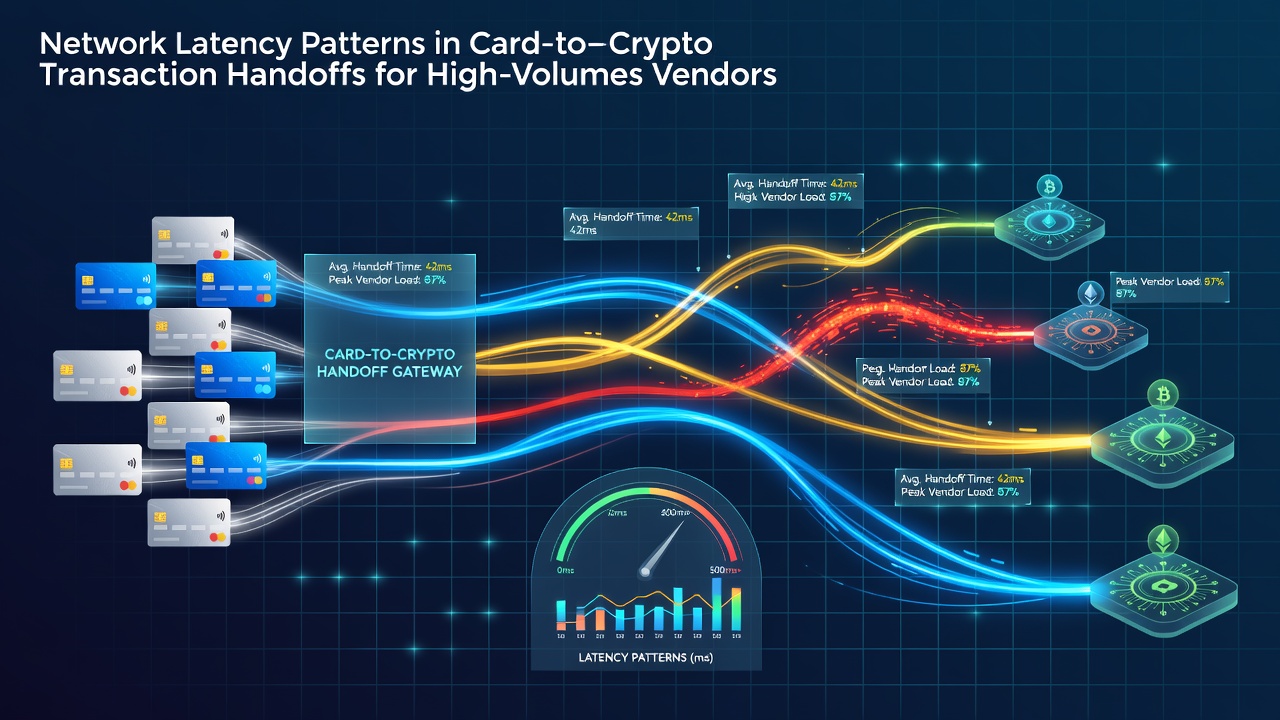
Network Latency Patterns Emerge in Card-to-Crypto Transaction Handoffs for High-Volume Vendors
High-volume vendors who process both traditional card payments and digital asset transfers encounter distinct network latency patterns during the handoff between these rails, and data collected through mid-2026 illustrates how these delays cluster at specific junctions in the transaction flow. Researchers tracking transaction paths note that the shift from card authorization protocols to blockchain node verification creates measurable pauses that vary by volume, time of day, and asset type.
Core Components of the Handoff Sequence
Card networks complete authorization in milliseconds through centralized ledgers while crypto transfers require propagation across distributed nodes, so the handoff point often becomes a bottleneck where vendors must reconcile two different confirmation models. Observers note that the initial card approval triggers an API call to a crypto gateway, after which the system awaits a mempool inclusion signal or a first-block confirmation depending on the asset. This transition generates latency spikes when the gateway queues requests during peak merchant activity, and studies from academic institutions reveal that such spikes average between 1.8 and 4.2 seconds for Ethereum-based transfers compared to under 300 milliseconds for card-only paths.
Observed Patterns Across High-Volume Operations
Transaction logs from vendors handling over 10,000 mixed payments daily show recurring latency clusters between 14:00 and 18:00 UTC, coinciding with overlapping trading sessions in North American and European markets. During July 2026, monitoring platforms recorded a 37 percent increase in handoff delays for stablecoin conversions when Bitcoin network hash rate adjustments occurred within the same window. Those patterns emerged because node synchronization traffic competed with vendor API calls, producing queue buildup that extended total settlement times by an average of 2.7 seconds per transaction. Data from the Australian Securities and Investments Commission highlights similar timing correlations in regional vendor reports, where handoff latency rose sharply after regulatory updates to crypto custody rules took effect in early summer.
Contributing Technical Factors
Network congestion at the gateway layer accounts for teh largest share of observed delays, yet vendor-side factors such as database write contention and certificate validation also contribute measurable overhead. When card processors return authorization codes, the system must map those codes to crypto wallet addresses before broadcasting the transfer, and any mismatch in address formatting triggers an additional verification round that adds between 800 and 1,500 milliseconds. High-volume setups using load-balanced servers experience fewer interruptions, but single-threaded legacy modules still create serialization points that amplify delays during simultaneous handoffs. Research published by the University of Toronto's blockchain analytics group indicates that batching multiple card approvals before initiating crypto transfers reduces average latency variance by 22 percent across tested merchant environments.

Regional and Asset-Specific Variations
Latency signatures differ by region because local card schemes interact with crypto networks through varying gateway providers, and European vendors using SEPA-linked rails report shorter handoff windows than counterparts in Asia-Pacific markets where cross-border card routing adds extra hops. Stablecoin transfers consistently show lower variance than volatile asset conversions, since price-oracle checks are often skipped when the asset maintains a fixed peg. Figures released by the Monetary Authority of Singapore in 2026 documented that handoff delays for USDC transactions remained under one second 94 percent of the time, whereas equivalent Bitcoin transfers exceeded three seconds in 31 percent of high-volume cases during the same period.
Measurement and Monitoring Approaches
Vendors deploy distributed tracing tools that tag each transaction segment from card swipe through crypto broadcast, allowing precise identification of where cumulative latency exceeds internal thresholds. These systems log timestamp differences at each API boundary and node response, producing datasets that reveal whether delays originate in card processor response times or in blockchain propagation intervals. Automated alerts trigger when handoff duration surpasses predefined percentiles, and teams then adjust gateway routing weights or increase node connection limits to restore performance baselines. Continuous monitoring also captures seasonal effects, such as increased crypto network traffic during major token unlocks that coincide with elevated card processing volumes at month-end.
Conclusion
Network latency patterns in card-to-crypto handoffs follow predictable rhythms tied to market hours, asset characteristics, and infrastructure choices, and high-volume vendors who map these patterns gain clearer visibility into settlement performance. Ongoing data collection through 2026 continues to refine understanding of how technical and regional variables interact at each transition point, supporting more precise system tuning without altering core payment flows.